The Myth of 'Chemical-Free' Sunscreen: Understanding Mineral vs. Chemical Filters

Unpacking the clean beauty misnomer
The phrase chemical-free sunscreen has become one of the most pervasive oxymorons in modern skincare. Plastered across pastel bottles, lifestyle forums, and boutique shelves, the label promises a purity that simply does not exist in nature or in the laboratory. If you have ever reached for a mineral sunscreen under the assumption that it was free from chemical compounds, your instinct was entirely understandable. Skincare marketing has spent the better part of two decades weaponizing vocabulary, teaching consumers that the word chemical is a synonym for toxic, synthetic, or dangerous, while natural stands as an unblemished beacon of health. Yet in cosmetic chemistry, as in fundamental physics, literally everything you can touch, spread, or pour is a chemical.
Water is a chemical. The sebum naturally resting on your nose is an intricate matrix of chemicals. Zinc oxide, the hero of the so-called clean sunscreen movement, is an inorganic chemical compound formed from zinc and oxygen atoms bonded in a crystalline lattice. Stripping the word of its sensationalism is not just an exercise in semantics; it is the essential first step toward making informed, effective decisions about protecting your skin. When we move past the false dichotomy of clean versus toxic, we can finally examine how photoprotection actually works on a molecular level.
The real physics of inorganic filters
In the scientific community, dermatologists and formulation chemists do not classify sunscreens as chemical versus natural. Instead, they divide photoprotective agents into two distinct categories: inorganic filters and organic filters. Inorganic filters, commonly referred to in consumer vernacular as mineral or physical filters, encompass two primary active ingredients: zinc oxide and titanium dioxide. For years, popular beauty lore taught that these minerals act as tiny mirrors resting atop the skin, bouncing one hundred percent of incoming ultraviolet rays back into the atmosphere like microscopic shields.
Modern photobiology tells a much more nuanced story. Rigorous optical studies have demonstrated that inorganic filters perform the majority of their photoprotective work through absorption, not reflection. Zinc oxide and titanium dioxide typically reflect and scatter only about four to five percent of incoming ultraviolet light, primarily in the visible and near-infrared spectrums. The remaining ninety-five percent of ultraviolet radiation is absorbed by the semiconductor band gap of the mineral crystal itself, which then transforms the high-energy photons into harmless, low-grade thermal energy. In short, mineral sunscreens protect your skin through largely the same fundamental thermodynamic mechanism as their organic counterparts.
How organic filters neutralize radiation
Organic filters—what commercial marketing labels chemical filters—are carbon-based aromatic compounds engineered to interact with specific wavelengths of light. Molecules such as avobenzone, octisalate, and the advanced European broad-spectrum filters are structured with conjugated double bonds. When a photon of ultraviolet light strikes an organic filter molecule, the molecule absorbs that energy, elevating its electrons into an excited, higher-energy orbital state. Rather than letting that dangerous energy penetrate deeper into cutaneous tissue to cause cellular and DNA damage, the molecule relaxes back down to its ground state by releasing the absorbed energy as imperceptible heat.
This process of photoprotective dissipation occurs continuously on the skin surface. Far from being a chaotic or destabilizing reaction, it is an exceptionally controlled photochemical event designed to preserve your cellular integrity. The innovation happening within French pharmacies has yielded formulations that remain remarkably photostable over prolonged exposure. When you look at an advanced formula like La Roche-Posay Anthelios UVMune 400 Oil Control Gel-Cream SPF50+ Fragrance-Free, you are seeing the culmination of decades of organic filter engineering, designed to bridge previously vulnerable gaps across ultra-long UVA rays without destabilizing under direct midday sunlight.

Texture, white cast, and cosmetic elegance
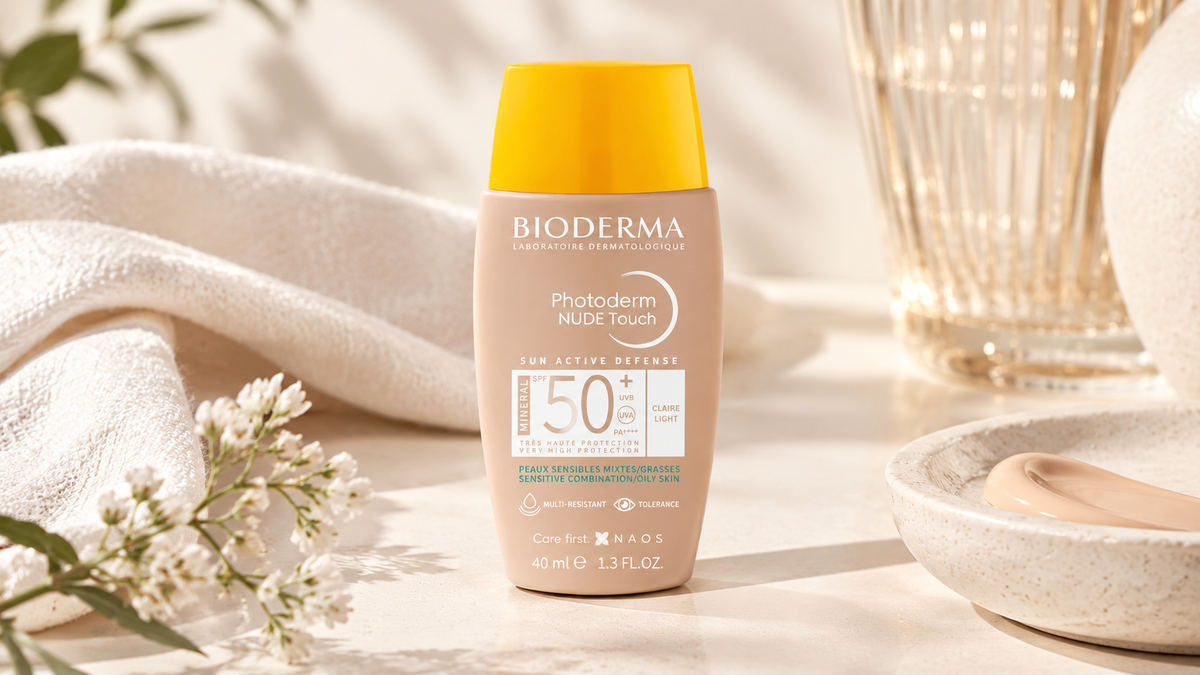
Because inorganic filters rely on dense mineral particles suspended in an emulsion, achieving an invisible finish has historically challenged formulators. Unless zinc oxide or titanium dioxide are micronized into nanoparticles or suspended in a tinted base, they naturally reflect visible light, creating the infamous chalky, purplish-white cast on deeper skin tones. Formulations like Bioderma Photoderm Nude Touch Mineral SPF50+ Light resolve this cosmetic dilemma by infusing mineral filters into a tinted, liquid-to-powder base that evens the complexion while delivering pure mineral photoprotection. For sensitive or reactive complexions, such inert mineral formulations remain an invaluable cosmetic tool.
Conversely, organic filters dissolve directly into the oil or water phase of an emulsion, unlocking sheer textures that would be physically impossible with mineral particles alone. A lightweight sunscreen like Vichy Capital Soleil UV-Clear Anti-Imperfections Water Fluid SPF 50+ capitalizes on these soluble organic filters to create an ultra-fluid, breathable finish that leaves zero residue on oily or blemish-prone complexions. Similarly, the celebrated Korean serum formula SKIN1004 Madagascar Centella Hyalu-Cica Water-Fit Sun Serum Twin Pack 2 x 50 ml proves how organic filters can melt into the skin like an everyday hydrating essence, dismantling the myth that high-factor sun protection must feel heavy, greasy, or occlusive.
The truth about absorption and safety
Much of the anxiety surrounding organic filters stems from clinical studies demonstrating that certain older UV filters can be absorbed transdermally into the bloodstream. Headings often frame systemic absorption as synonymous with systemic harm, yet in toxicology, the presence of a compound in the body does not automatically equate to a biological hazard. Decades of peer-reviewed safety reviews conducted by the European Commission's Scientific Committee on Consumer Safety (SCCS) have established clear safety margins for approved filters, holding them to exceptionally high standards before they ever arrive on a pharmacy shelf.
European regulatory frameworks frequently approve advanced large-molecule filters that possess higher molecular weights, drastically minimizing the potential for skin penetration while providing superior broad-spectrum photostability. Products like Eucerin Pigment Control SPF 50+ Sun Fluid demonstrate how sophisticated organic filter combinations can be paired with brightening active ingredients to support a more even-looking complexion safely and effectively. Choosing between mineral and organic filters is not a referendum on safety; it is simply a matter of finding the vehicle that best supports your personal skin barrier, lifestyle, and aesthetic preference.
 Bioderma Photoderm Nude Touch Mineral SPF50+ Light 40ml$23.0
 Eucerin Pigment Control SPF 50+ Sun Fluid 50ml$21.8 $27.0
 Vichy Capital Soleil UV-Clear Anti-Imperfections Water Fluid SPF 50+ – 40 ml$28.7 $34.0
 La Roche-Posay Anthelios UVMune 400 Oil Control Gel-Cream SPF50+ 50ml Fragrance-Free$23.8 $31.0
 SKIN1004 Madagascar Centella Hyalu-Cica Water-Fit Sun Serum Twin Pack 2 x 50 ml$22.5 $30.0
Finding your personal formulation match
When navigating sunscreen selection, the most important metric is consistency of use. The absolute best sunscreen is not the one with the most virtuous marketing claim on its carton; it is the formula you are genuinely eager to apply every single morning in generous amounts. If you struggle with sensitivity or skin that feels easily reactive, a 100% mineral fluid like Bioderma Photoderm Nude Touch Mineral SPF50+ Light offers peace of mind with its inert physical profile and matte, complexion-correcting finish.
If your primary daily concerns are effortless makeup layering, invisible protection on diverse skin tones, or managing breakout-prone skin under high humidity, organic options remain unmatched in their weightless wear. Formulas such as Vichy Capital Soleil UV-Clear Anti-Imperfections Water Fluid SPF 50+ or La Roche-Posay Anthelios UVMune 400 Oil Control Gel-Cream SPF50+ Fragrance-Free eliminate all excuses for skipping daily photoprotection. Ultimately, shedding the clean beauty guilt frees you to treat sunscreen as what it has always been: your single most powerful dermatological investment.
Frequently asked questions
Do mineral sunscreens work by acting as a total mirror on skin?
No. While mineral filters do reflect a small percentage of visible and infrared light, scientific studies confirm that zinc oxide and titanium dioxide absorb approximately ninety-five percent of UV rays, dissipating them as low-level heat.
Is mineral sunscreen inherently safer than chemical sunscreen?
Not inherently. All approved organic and inorganic filters undergo rigorous safety and toxicological evaluations by regulatory health authorities, making both categories safe for daily consumer use.
Why do European organic sunscreens feel different from American formulas?
European regulators have approved modern broad-spectrum organic filters that are exceptionally photostable and cosmetically elegant, allowing European pharmacy brands to formulate lighter, less greasy textures with high broad-spectrum coverage.
Can you layer a mineral sunscreen over a chemical sunscreen?
Yes, you can layer them if desired, provided each layer is allowed to dry down fully and the formulas do not destabilize each other through excessive friction or incompatible emulsifiers.