Article: The Hair Care Mistake: Using Conditioner Only on Hair Ends
The Hair Care Mistake: Using Conditioner Only on Hair Ends

The persistent myth of hair ends
If you learned hair care during the early two thousands, chances are you received a strict, universal decree: apply your conditioner strictly to the bottom two inches of your strands, rinse immediately, and never let a drop touch anywhere higher. The logic was understandable at the time. Most of us were terrified of flat roots, greasy crowns, and the midday collapse of whatever volume we had coaxed from a blow dryer. That cautionary advice spread so effectively across beauty magazines and salon chairs that it became an unexamined ritual for millions of people.
Yet when you look closely at hair health, this well-meaning habit creates an entirely new set of frustrations. You might notice that your very ends look adequately hydrated, but your mid-lengths—the vast stretch of hair between your jawline and the tops of your shoulders—remain rough, matte, and stubbornly prone to static. If you have ever felt a sudden snag halfway down a brush stroke, or wondered why your blowout looks frizzy at ear level despite generous product at the bottom, your application technique is almost certainly the quiet culprit.
The reassuring truth is that conditioning above the very tips does not ruin your volume, weigh down your roots, or cause instant grease when done with the proper technique. Hair is not a binary structure of fresh scalp versus brittle tips; it is a continuous, living gradient of fiber that endures friction, washing, styling, and environmental exposure along every single centimeter. Reworking this single shower habit brings immediate relief, restoring suppleness and uniform shine across the entire length of your hair without sacrificing airy movement.
Understanding the anatomy of mid-lengths
To understand why mid-lengths require deliberate moisture, it helps to examine what a hair fiber experiences as it emerges from the follicle. Each strand is wrapped in a protective, shingle-like outer layer called the cuticle, bound together by natural lipids and 18-methyleicosanoic acid (18-MEA), the delicate fatty acid film that lends virgin hair its water-repellent smoothness. At the root, this lipid barrier is pristine and continuously replenished by natural sebum produced in the scalp.
By the time that strand reaches ear level, however, it has survived months—or even years—of daily life. It has rubbed against wool coats, silk scarves, car seats, and pillowcases. It has weathered ultraviolet sunlight, hot water, towel rubbing, and ambient dryness. Natural sebum simply cannot travel down long or textured hair efficiently enough to maintain the cuticle layer on its own. As a result, the mid-lengths experience progressive lipid depletion, causing the cuticle scales to lift, tangle against neighboring strands, and lose their natural reflective gloss.
When you confine your conditioning product solely to the last inch of hair, you leave the hardest-working part of the shaft unshielded. The cuticle scales along the mid-length remain slightly raised after shampooing, creating microscopic snag points where hair tangles during styling. Re-introducing conditioning emollients, fatty alcohols, and cationic conditioning agents to this intermediate zone seals the cuticle flat, dramatically reduces friction during detangling, and protects the structural integrity of the cortex long before split ends ever have a chance to form.
The French pharmacy approach to hair
In the French pharmacy tradition, hair care has never been viewed as an aggressive correction of aesthetic flaws, but rather as an exercise in biological equilibrium. The golden rule is clear and simple: treat the scalp as living skin, and treat the lengths as delicate textiles. When you establish this mental separation, the fear that applying conditioner to mid-lengths will cause greasy roots dissolves instantly, because the scalp and the hair strand are treated with distinct, targeted steps.
A healthy hair routine begins with an immaculate foundation at the scalp. When the scalp feels comfortable and hair roots naturally retain lift and lightness, everything else follows more easily. This is why French dermatological laboratories focus intensely on scalp-focused formulations. When persistent flaking, excess oil, or scalp sensitivity arises, targeted treatments such as Ducray Kelual DS Anti-Dandruff Treatment Shampoo Original 100ml or Bioderma Nodé DS+ Intense Anti-Dandruff Shampoo 125ml work directly at the scalp surface to help visibly reduce the appearance of flakes and leave the scalp feeling comfortable and refreshed.
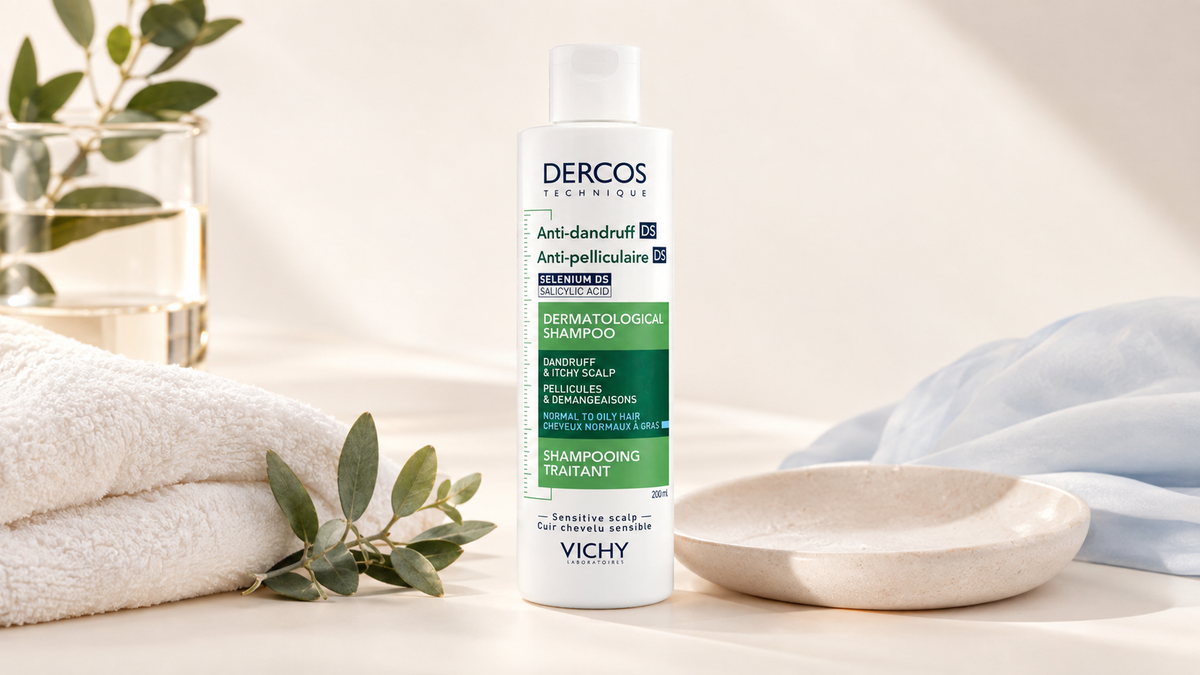
Similarly, formulations like Vichy Dercos Technique Anti-Dandruff DS Shampoo 200 ml and Vichy Dercos Technique Anti-Dandruff DS Shampoo Normal to Oily Hair 390 ml cleanse and refresh the scalp without aggressive stripping, leaving hair feeling clean, light, and ready to style. For everyday family care or ultra-sensitive scalps, a mild botanical cleanser like Mustela Gentle Shampoo with Organic Avocado – 200ml provides gentle surface hygiene that respects natural barriers. Once your scalp cleansing is dialed in, your lengths are free to receive the moisture they require without any lingering anxiety about heaviness.
-
1. Cleanse scalp and rinse thoroughly
Wash your scalp deliberately with lukewarm water, focusing your cleanser at the roots to clear sebum and buildup before rinsing clean.
-
2. Squeeze out excess water
Gently press hair between your palms or a microfiber cloth to remove excess soaking water, ensuring the conditioner can adhere directly to the fiber.
-
3. Dispense and warm between hands
Measure a coin-sized amount of conditioner and rub your palms together to create a light, even emulsion across your fingertips.
-
4. Apply starting at ear level
Gather your hair into loose sections and begin working the product from the level of your earlobes downward, raking fingers through the mid-lengths.
-
5. Comb through with wide teeth
Use a wide-tooth shower comb or your fingers to distribute the conditioner evenly from mid-shaft to ends, smoothing the cuticle and gently clearing knots.
-
6. Rinse completely with lukewarm water
Allow the formula to rest for two to three minutes, then rinse meticulously until the water runs clear and hair feels silky rather than coated.
Diagnosing your hair fiber needs
A common hesitation when extending conditioner into mid-lengths is the worry that one's specific hair type cannot tolerate the added nourishment. The reality is that every hair profile benefits from mid-length hydration; the only variable that changes is the weight of the formula and the exact starting line of your application. Listening to your fiber helps you calibrate your technique with absolute precision.
Fine hair, contrary to popular belief, often sustains more physical friction damage than coarser textures because the strand diameter is inherently fragile. If your hair is fine, choose a lightweight conditioning milk or a lotion rich in plant-derived amino acids and featherweight esters. Begin applying right at the nape of the neck or just below the jawline, keeping your hands moving continuously to coat strands uniformly without concentrating heavy deposits in any single area.
Coarse, curly, or chemically treated hair, on the other hand, possesses an irregular strand shape where natural scalp sebum struggles significantly to travel downward. For these hair types, conditioning should begin higher—frequently at cheekbone or mid-ear level—using richer emollients, fatty acids, and nourishing oils. Applying conditioner generously through the mid-section creates slip, preventing breakage during the wash process and locking in essential elasticity.
 Vichy Dercos Technique Anti-Dandruff DS Shampoo 200 ml$21.5 $25.0
 Vichy Dercos Technique Anti-Dandruff DS Shampoo Normal to Oily Hair 390 ml$26.4 $29.5
 Mustela Gentle Shampoo with Organic Avocado – 200ml$12.95
 Ducray Kelual DS Anti-Dandruff Treatment Shampoo Original 100ml$23.8 $29.0
 Bioderma Nodé DS+ Intense Anti-Dandruff Shampoo 125ml$20.0 $24.0
The science of wet detangling
One of the most consequential benefits of bringing conditioner through the mid-lengths is the mechanical protection it affords during detangling. When hair absorbs water in the shower, its internal hydrogen bonds temporarily weaken, rendering the strand up to thirty percent more stretchy and vulnerable to structural snapping. Trying to drag a comb or fingers through damp, unconditioned mid-lengths creates severe friction that literally tears the outer cuticle layer apart.
Conditioning formulas rely on positively charged molecules that naturally seek out the negatively charged, weathered regions of the hair cuticle. By neutralizing static charges and lowering the coefficient of friction along the hair surface, conditioner allows individual strands to slide past one another effortlessly. When you smooth conditioner through the mid-lengths and follow with a wide-tooth comb, knots dissolve under minimal tension, preserving the natural density and taper of your hair over time.
Always begin detangling from the very tips, gently working out small snags before moving your comb up into the conditioned mid-lengths. This bottom-up progression ensures that you never push existing knots down into tighter, more stubborn clumps. By the time your comb glides freely from ear level down through the ends, your cuticles are aligned and ready for a gentle, thorough rinse.
Water temperature and final rinsing
Even with an impeccable application through the mid-lengths, the final rinse determines whether your blowout retains buoyancy or feels weighed down. A widespread belief suggests that shocking your hair with freezing water closes the cuticle and locks in shine. In truth, hair cuticle cells are non-living biological structures that do not open and contract like living skin pores in response to extreme temperatures. Freezing rinses simply cause discomfort without providing structural advantages.
Instead, lukewarm water is optimal for rinsing conditioned lengths. Lukewarm water effectively emulsifies and lifts away excess conditioning agents that have not adhered to the strand, preventing heavy residue from drying down on your mid-shaft. If you leave excess surfactant or emollient residue behind, your hair may feel slightly tacky once dry, which attracts atmospheric dust and gives the impression of premature greasiness.
Take an extra thirty seconds under the stream to ensure thorough water flow through the back and underside of your head. Lift the mid-lengths gently so water circulates freely around every section. Your hair is adequately rinsed when it feels silky, cool, and fluid to the touch, with no slick film remaining on your palms or nape. This disciplined finish ensures your strands catch the light cleanly from cheekbone to collarbone.
Frequently asked questions
Will applying conditioner to my mid-lengths make my hair look flat?
Not when applied correctly to squeezed, damp hair starting at ear level. Flatness occurs when heavy conditioner is rubbed directly onto the scalp or roots, or when hair is inadequately rinsed with lukewarm water.
How do I know where my mid-lengths begin?
A reliable guideline is the bottom of your earlobes or jawline. Everything below this line has experienced significant friction, washing, and environmental exposure and will benefit from the protective emollient coating of conditioner.
Should I comb my hair before or after applying conditioner in the shower?
Gently detangling dry hair with a soft brush before stepping into the shower is ideal. Once in the shower, only comb wet hair after applying conditioner to the mid-lengths and ends, which provides the necessary slip to prevent breakage.
Can I use leave-in conditioner instead of conditioning my mid-lengths in the shower?
Rinse-out conditioners work in tandem with rinse water to align the hair cuticle and neutralize wet-friction charges immediately after washing. A lightweight leave-in conditioner can serve as a wonderful post-shower supplement, but it is rarely a full replacement for proper in-shower conditioning.
How often should I condition my hair if I have oily roots?
You can condition your mid-lengths and ends every single time you shampoo your hair. Because you are focusing the conditioning emulsion strictly below the jawline, your roots remain clean and buoyant while your lengths receive essential barrier defense.
Redefining your daily hair cadence
Transitioning from the old habit of conditioning only your bottom inches to an intentional, mid-length method transforms the tactile quality of your hair almost immediately. Within one or two washes, the persistent crunchiness at the nape of your neck softens, your hair falls in cohesive ribbons rather than scattered frizz, and morning styling requires noticeably less heat and product to look polished.
Hair care is ultimately a practice of mindful stewardship rather than rigid rules. Once you abandon the fear of weighing down your crown and begin honoring the genuine structural needs of your hair fiber, the entire routine feels lighter and more intuitive. By pairing thoughtful scalp care with complete, cuticle-sealing hydration across your lengths, you give every single strand the balanced foundation it deserves.