Article: The Myth of 'Purity' in Skincare: Why Formulations Need More Than Just 'Natural' Ingredients
The Myth of 'Purity' in Skincare: Why Formulations Need More Than Just 'Natural' Ingredients

The seduction of the untouched botanical
For over a decade, beauty marketing has relied on a seductive narrative: that purity is synonymous with efficacy, and that an ingredient plucked directly from a meadow is inherently safer and more virtuous than one synthesized in a laboratory. It is an intuitive belief. We want our food unadulterated, our water crisp from natural springs, and our air clean. Transferring that desire for pastoral simplicity onto our faces feels like an act of genuine self-care. Yet, the skin does not read ingredient labels with emotional nostalgia. It is an organ governed by biochemistry, cellular architecture, and immunological tolerance.
When skincare promises total purity, it usually presents an idealized version of nature while glossing over the realities of organic chemistry. Raw botanical extracts are chemically chaotic. A single plant extract can contain hundreds of separate molecular constituents, including volatile terpenes, oxidizable lipids, and photosensitizing compounds that fluctuate based on soil quality, seasonal rainfall, and harvest methods. Far from being gentle, unrefined natural extracts are among the most frequent culprits behind contact dermatitis and sensitized skin barriers. True dermal comfort requires strict chemical control, balance, and thoughtful synthesis.
Deconstructing the clean beauty dichotomy
The premise that laboratory-synthesized molecules are inherently toxic while raw botanical oils are fundamentally healing is one of the most durable falsehoods in modern wellness. In cosmetic formulation, safety is a matter of molecular size, chemical stability, dosage concentration, and biocompatibility, not historical provenance. Synthetic ingredients are frequently engineered specifically to remove the irritating, allergenic, or unstable components found in their plant-derived counterparts, yielding a molecule that delivers singular, predictable cosmetic benefit.
Consider petroleum jelly and refined mineral waxes, long vilified by purity marketing as industrial contaminants. Highly purified petrolatum, such as the pharmaceutical-grade core found in Eucerin Aquaphor Baume Réparateur Skin Repair Balm 40g, is chemically inert. Because it possesses no fragrance fractions, active allergens, or botanical impurities, it sits comfortably over sensitized skin without triggering unwanted skin responses. Its long carbon chains create an occlusive film that helps the skin's surface retain moisture while remaining non-comedogenic and hypoallergenic. Dismissing such molecules out of hand simply because they originate in a laboratory deprives vulnerable skin barriers of the most reliable protective chemistry known to science.
The critical necessity of modern preservation
Perhaps the most dangerous casualty of the purity myth is the modern preservative system. In an effort to declare products free of traditional stabilizers, some clean skincare lines turn to weak organic acid blends, essential oils, or grapefruit seed extract, leaving the aqueous phase vulnerable to microbial colonization. Any skincare formulation containing water without an airtight, broad-spectrum preservative system is a welcoming host for gram-negative bacteria, mold, and yeast within weeks of opening.
Preservatives are not toxic fillers; they are essential safety shields. When a jar of natural cream is contaminated with pathogens like Pseudomonas aeruginosa or Staphylococcus aureus, applying it to the delicate facial skin or chapped lip tissue can lead to significant skin discomfort and visible irritation. Modern clinical formulations balance preservation with physiological tolerance, ensuring that the product maintains its microbiological integrity from the first pump to the last drop without causing dermal sensitization.
Why the skin barrier demands structural precision
The stratum corneum operates like a brick wall: corneocytes act as the bricks, embedded in an intercellular matrix of ceramides, cholesterol, and free fatty acids. This lipid architecture requires precise molar ratios to remain impermeable against pathogens and environmental moisture loss. Slathering pure plant oils onto a depleted skin barrier often falls short of restoring this complex biological architecture because plant lipids, while rich in oleic or linoleic acids, lack the physiological proportion of ceramides and sterols required for genuine barrier support.
In contrast, French pharmacy formulations approach barrier care through an ecobiological lens. Rather than attempting to swamp the skin with botanical extracts, they provide targeted physiological building blocks. A product like La Roche-Posay Cicaplast Baume B5+ Ultra-Repairing Soothing Balm 100ml pairs panthenol (provitamin B5) with purified madecassoside and a targeted mineral complex. Instead of using whole, unstandardized centella asiatica leaf paste, cosmetic chemists isolate madecassoside to ensure batch-to-batch molecular consistency, stripping away irritating plant sugars and tannins to deliver uninterrupted epidermal soothing.
 Homeoplasmine Soothing Multipurpose Balm 40g – Protective Skin Care by Boiron$13.95 $18.0
 La Roche-Posay Cicaplast Baume B5+ Ultra-Repairing Soothing Balm 100ml$23.0
 Eucerin Aquaphor Baume Réparateur Skin Repair Balm 40g$8.4 $15.95
 Uriage Bariéderm-CICA Cream with Copper-Zinc 40ml – Repairs & Soothes$11.9 $19.0
 Grahams Face & Eyelid Eczema Cream 50g$16.95
Stability, oxidation, and the trouble with botanicals
Plant oils rich in polyunsaturated fatty acids are structurally vulnerable. Exposed to ultraviolet light, heat, and air, their double bonds oxidize rapidly, generating reactive lipid peroxides and free radicals that can deplete the skin's endogenous antioxidant stores and contribute to the appearance of skin discomfort. Many unrefined botanical oils spoil quickly on the shelf, altering their scent, texture, and cellular compatibility long before the bottle is half empty.
To overcome this biological fragility, modern cosmetic chemistry utilizes refined, stabilized carriers and synergistic mineral shields. Consider Uriage Bariéderm-CICA Cream with Copper-Zinc 40ml – Repairs & Soothes, which relies on a specialized insulating polymer complex combined with copper and zinc trace elements. This synthetic matrix creates a physical shield over weakened skin, preventing friction and bacterial proliferation while the underlying tissues recover. No single unrefined plant oil can replicate this degree of durable, non-greasy physical isolation.
The French pharmacy approach to skin tolerance
France's clinical skincare heritage grew not out of romanticized pastoral myths, but from a rigorous tradition of medicinal chemistry and hospital dispensary care. French dermatologists and pharmacists recognized decades ago that sensitive skin does not require fifty botanical extracts; it requires fewer, purer, and more clinically tested raw materials. The philosophy has always been reductionist: eliminate known irritants, stabilize proven actives, and support the skin's natural physiological pathways without unnecessary disturbance.
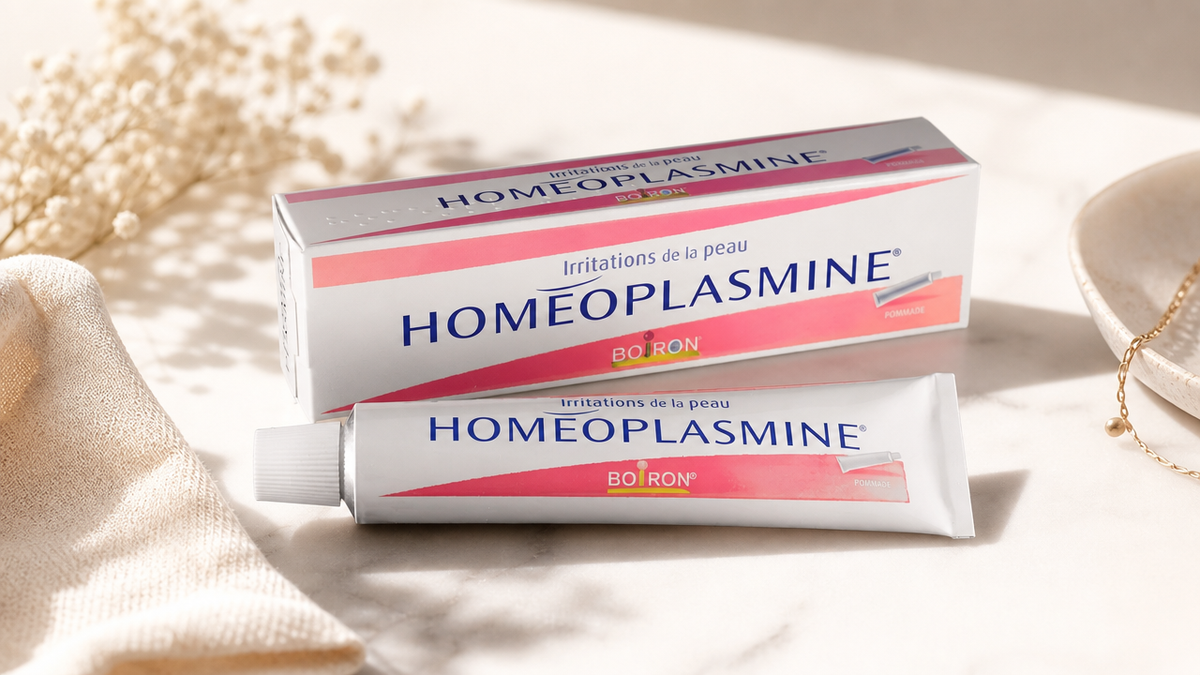
This philosophy is evident in heritage staples like Homeoplasmine Soothing Multipurpose Balm 40g – Protective Skin Care by Boiron, a classic French medicine cabinet fixture formulated with carefully selected, purified active fractions within an emollient protective base. It is designed to soothe dry, irritated surfaces like windburned cheeks and chapped noses without superfluous sensory additives. Similarly, targeted solutions like Grahams Face & Eyelid Eczema Cream 50g focus on delivering deliberate, biocompatible soothing designed explicitly for fragile facial areas, respecting the physiological threshold of easily irritated skin.
Rethinking purity as intentional cosmetic design
It is time to redefine what pure really means in the context of everyday skincare. Purity is not the absence of synthetic intervention, nor is it the unquestioned inclusion of everything that sprouts from fertile soil. True purity in skincare formulation is chemical predictability, microbiological sterility, and unwavering biological safety. It is the assurance that every single molecule inside the container serves a clear, purposeful role for the skin's surface, free of unexpected contaminants, unstable volatile oils, and deceptive sensory marketing.
When choosing your daily regimen, look past idyllic botanical claims and pastoral branding. Seek out formulations grounded in physiological logic, high-tolerance testing, and molecular refinement. Whether you are managing the look and feel of dry winter skin, supporting a depleted moisture barrier, or calming the appearance of reactive skin, trusting balanced formulation chemistry over the myth of natural purity is the most compassionate choice you can make for your skin.
Frequently asked questions
Are natural ingredients always safer for sensitive skin?
No, natural ingredients often contain complex mixtures of volatile compounds, terpenes, and potential allergens that can trigger contact dermatitis. Synthetic molecules and purified pharmaceutical extracts are strictly controlled for consistent purity and biological tolerance.
Why do clinical skincare formulas use synthetic occlusives?
Synthetic and mineral occlusives like pharmaceutical-grade petrolatum are chemically inert, meaning they do not oxidize or react with the skin's immune cells. They create a reliable, breathable barrier that shields vulnerable skin from transepidermal water loss without causing irritation.
Is clean beauty better for repairing a damaged skin barrier?
Not necessarily, because clean beauty formulations often lack the precise physiological lipid ratios and targeted stabilizers required to rebuild the stratum corneum. Clinical barrier creams rely on isolated, well-researched actives that support cellular recovery without unnecessary botanical noise.
Can unrefined botanical oils go bad on the skin?
Yes, unrefined oils rich in polyunsaturated fatty acids oxidize quickly when exposed to light and air. Oxidized lipids can generate free radicals and cause micro-inflammation, accelerating barrier compromise rather than soothing it.