The Myth of 'Over-Washing' Your Face: How to Cleanse Effectively Without Stripping Skin

Rethinking the cleanse
The skincare internet has spent the better part of a decade convincing everyone that washing your face is a dangerous pursuit. According to popular social media lore, washing twice a day invites barrier destruction, triggers a catastrophic rebound of excess oil, and strips away vital microflora that can never truly recover. The prevailing advice across forums and influencer routines has often swung toward the opposite extreme: wash only with plain water in the morning, or rinse sparingly at night, treating cleansers as a necessary evil to be deployed as infrequently as humanly possible.
This well-intentioned backlash was an understandable reaction to the harsh, high-pH bar soaps and astringent scrubs of the nineteen-nineties and early two-thousands. Those legacy formulas genuinely did decimate the acid mantle, leaving the skin feeling tight, squeaky, and visibly inflamed. But the conclusion that cleansing itself is inherently harmful misses the mark. The issue was never the frequency of cleansing; it was always the chemistry of the surfactant system and how modern skin interacts with urban life.
Far from being a virtue, under-cleansing presents its own suite of complications. Throughout the day, the skin surface accumulates an intricate emulsion of oxidized sebum, particulate matter from urban pollution, shed corneocytes, and water-resistant chemical UV filters. Leaving this residue overnight or simply splashing it with tepid water in the morning leaves stale lipids sitting atop porous skin tissue. The goal of a disciplined skincare routine is not to preserve stale surface oil out of fear, but to cleanse with intention, clearing debris without dismantling the delicate intercellular matrix.
The chemistry of the acid mantle
To understand why cleansing gets misunderstood, one must look closely at the stratum corneum and its protective lipid envelope. The surface of healthy human skin sits at an acidic pH, typically ranging between 4.5 and 5.5. This slightly acidic environment—termed the acid mantle—is sustained through the secretion of free fatty acids from sebum, lactic acid in sweat, and sodium-hydrogen antiporters in living epidermal layers. This acidity is essential because the enzymatic machinery responsible for producing ceramides and processing cholesterol operates optimally within this tight pH window.
When you wash with a conventional harsh soap derived from saponified fatty acids, its alkaline pH—often between 8.0 and 10.0—elevates the skin's surface pH for several hours. In that elevated environment, enzymatic lipid synthesis slows, and swelling occurs within the stratum corneum, allowing critical natural moisturizing factors to leach out into the rinse water. The tight, dry sensation following such an encounter is not proof of cleanliness; it is the physical sensation of dehydrated keratinocytes and swollen cellular architecture.
Modern French pharmacy cleansing approaches this challenge from an entirely different mechanical starting point. Rather than employing aggressive anionic detergents like sodium lauryl sulfate, sophisticated formulas use mild amphoteric surfactants, non-ionic glucoside cleansers, and buffered pH systems designed to match the native acid mantle. When formulated with this level of restraint, water and surfactant effectively solubilize foreign grime and excess lipid without denaturing the skin's structural proteins.
The rebound oil fallacy
Perhaps the most enduring myth surrounding the concept of over-cleansing is the notion of rebound oiliness: the idea that washing your face triggers a direct, rapid feedback loop that instructs your sebaceous glands to flood the skin with even more sebum. The biological reality is considerably more nuanced. Sebaceous gland activity is influenced by a complex interplay of internal and external factors rather than direct mechanical feedback sensors located at the surface of the stratum corneum.
Your sebaceous glands cannot sense whether a surfactant swept across your cheek twenty minutes ago. What people interpret as a rebound surge in oil is actually a breakdown in barrier function coupled with transepidermal water loss. When an aggressive cleanser strips the superficial lipid bilayer, moisture evaporates from the lower layers rapidly. Skin can feel tight and uncomfortable, fine lines become more visible, and normal, baseline sebum production continues unabated underneath.
Without a coherent moisture barrier to hold that natural sebum in a balanced, protective emulsion, the oil simply pools on the surface of dehydrated, flaky tissue, creating an uncomfortable, greasy sheen. The solution is not to surrender cleansing altogether and allow stale oil to oxidize. The remedy is to clean thoroughly with a physiological formula that leaves the skin barrier calm, balanced, and intact.
Selecting the right surfactant profile
Navigating the cleansing aisle requires discerning between products designed to strip and those engineered to purify. For combination, oily, or blemish-prone skin, the instinct is often to reach for drying solutions that create a squeaky, parched aftermath. French dermatological laboratories have long rejected that philosophy, developing foaming formulas that clear pores through gentle solubilization rather than blunt-force degreasing.
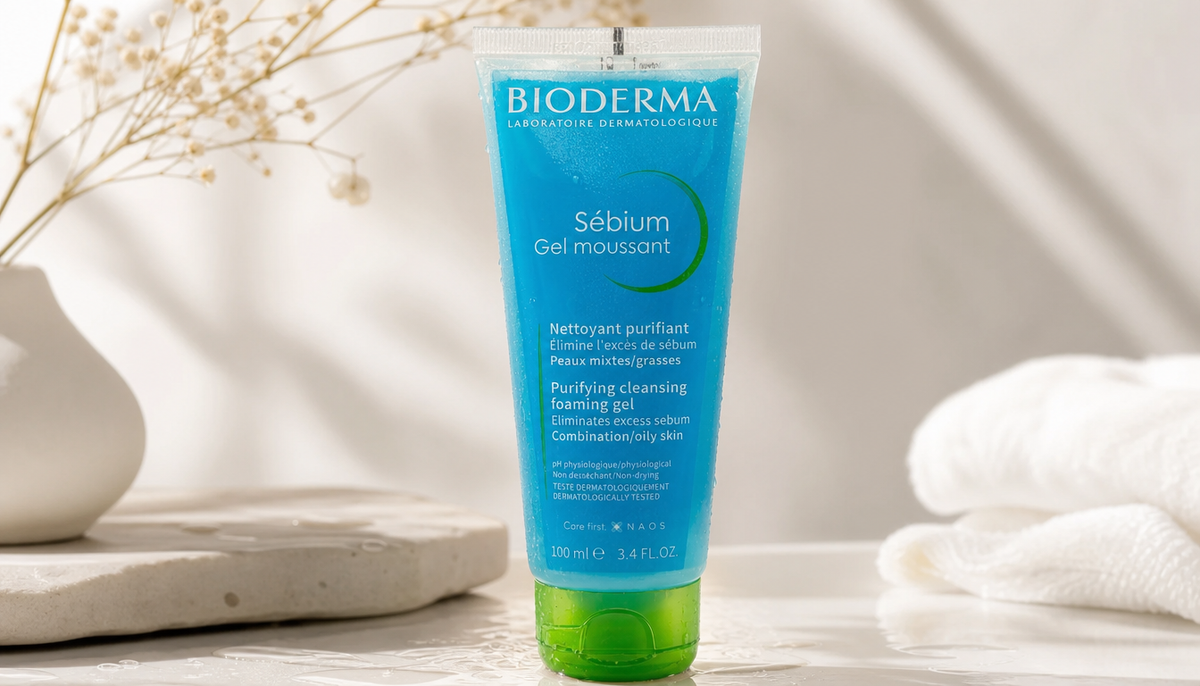
A standard-bearer in this category is Bioderma Sébium Purifying Cleansing Foaming Gel 100ml. Created specifically for oily and combination profiles, it relies on gentle cleansing agents that effectively suspend sebum and environmental residue without compromising barrier comfort. By balancing effective purification with dermatological gentleness, it disproves the premise that oily skin must choose between persistent congestion and dry irritation.
Men's skin presents another relevant case study in the dynamics of daily cleansing. Due to higher androgen concentrations, male facial skin is typically thicker and produces significantly more sebum throughout the day, often complicated by the micro-irritations of daily shaving. Using an inadequate wash can allow sebum to build up around hair follicles, leading to dullness and ingrown hairs. Formulas like Biotherm Homme Aquapower Cleanser 125ml are designed to navigate this balance, offering a thoroughly refreshing cleanse that sweeps away sweat and daily impurities while maintaining skin hydration and comfort.
 Bioderma Sébium Exfoliating Purifying Gel 100ml – Unclogs & Smooths Oily/Combination Skin EXP:08/26$11.2 $21.0
 Bioderma Sébium Purifying Cleansing Foaming Gel 100ml$11.95 $15.0
 Bioderma Sébium Kerato+ Anti-Blemish High Tolerance Gel-Cream 30ml$18.0 $21.0
 Biotherm Homme Aquapower Cleanser 125ml$24.48 $34.0
Exfoliation versus daily cleansing
Another common source of confusion in the over-washing conversation is the conflation of daily washing with deep mechanical or chemical exfoliation. Washing is a daily maintenance step intended to remove exogenous soil, sunscreen, and oxidized surface debris. Exfoliation, by contrast, is a targeted intervention designed to accelerate the desquamation of cohesively bound corneocytes that fail to shed naturally.
When people complain that washing their face three times in a single day ruined their skin, an audit of their routine often reveals they were using an abrasive bead scrub or an aggressive exfoliating wash on every single occasion. That is not over-cleansing; that is over-exfoliating. Physical friction and high-potency acids should be incorporated intentionally, tailored to skin tolerance, rather than treated as an everyday soap replacement.
For congested skin that benefits from regular texture refinement, incorporating a product like Bioderma Sébium Exfoliating Purifying Gel 100ml – Unclogs & Smooths Oily/Combination Skin EXP:08/26 provides a measured approach. Rather than relying on jagged physical irritants, it combines gentle mechanical action with targeted purifying ingredients to clear pore blockages and smooth the skin surface, making it an ideal supplemental treatment used once or twice weekly rather than an aggressive daily habit.
The evening ritual and sun protection
Nowhere is the necessity of thorough cleansing more evident than in the context of modern sunscreens and long-wearing cosmetics. Contemporary UV filters—particularly water-resistant formulations engineered to withstand perspiration, heat, and physical movement—are chemically formulated to adhere stubbornly to the skin surface. They do not break down with a simple splash of water, nor can they be adequately cleared by wiping the face with a dry towel.
When these long-wearing film-formers remain on the skin overnight alongside accumulated urban grime, they can mingle with normal sebum within the hair follicle, creating an environment that may contribute to the appearance of blemishes and congested-looking pores. Cleansing at the end of the day is not an indulgence or a threat to your skin barrier; it is essential hygiene for anyone living in an environment with artificial light, ambient pollution, and daily SPF wear.
Following evening purification, pairing a clean skin surface with high-tolerance restorative care allows active ingredients to absorb without fighting through a barrier of stale lipids. A product like Bioderma Sébium Kerato+ Anti-Blemish High Tolerance Gel-Cream 30ml is formulated to work harmoniously on thoroughly cleansed, blemish-prone skin, supporting smoother texture and clearer pores while maintaining optimal skin comfort and tolerance.
Adapting routine to circumstance
Rather than adhering to rigid internet dogma declaring that everyone must wash precisely once or twice daily, effective skin maintenance requires contextual observation. Your cleansing frequency should adjust based on your climate, humidity, activity level, and daytime product use. The athlete who works out during their lunch break should never feel guilty about washing their face after a sweat session, provided they reach for an ultra-gentle, physiological cleanser rather than a harsh stripping agent.
Similarly, individuals living in densely populated urban centers or regions with elevated seasonal humidity accumulate significantly more environmental debris on their skin than someone residing in a cool, dry climate indoors. Listening to your skin does not mean abandoning cleansing when feeling oily; it means assessing whether your current cleanser leaves your skin soft, supple, and calm, or tight, prickly, and flushed.
If your skin feels parched sixty seconds after blotting it dry with a towel, your cleanser is the culprit—not the act of washing itself. Replacing an aggressive formulation with a balanced, gentle French pharmacy wash allows you to maintain hygienic purity twice daily while leaving the structural lipid matrix completely untouched.
Frequently asked questions
Is washing my face twice a day bad for my skin barrier?
Washing twice daily is completely safe and beneficial for most skin types, provided you use a gentle, low-pH cleanser. Skin issues arise from harsh surfactants and excessive friction, not from the simple frequency of using a well-formulated, barrier-respecting wash.
Does washing my face make it produce more oil?
No. Sebaceous gland output is primarily driven by internal hormones rather than surface washing. What people perceive as rebound oiliness is often surface dehydration, where compromised skin lacks the moisture barrier needed to properly hold its natural sebum in balance.
Can I just wash my face with plain water in the morning?
Water effectively rinses away water-soluble sweat and saliva, but it cannot dissolve lipid-soluble residues such as nighttime creams, oxidized sebum, or dead skin cells. If your skin is prone to congestion, a gentle morning cleanser is generally preferable to water alone.
How do I know if my cleanser is too harsh?
If your face feels tight, looks visibly shiny in a plastic-like manner, stings when you apply moisturizer, or feels dry and itchy immediately after toweling off, your cleanser is disrupting your stratum corneum lipids and should be swapped for a gentler alternative.