Article: The SPF Mistake: Forgetting Sun Protection on Cloudy Days
The SPF Mistake: Forgetting Sun Protection on Cloudy Days

The quiet misconception of overcast skies
There is a particular stillness to an overcast morning. You wake up to a soft, slate-grey sky that feels almost protective, muting the harsh glare of the world outside and inviting you to step out in a soft knit with bare, unbothered skin. On mornings like these, reaching for a dedicated sunscreen bottle can feel counterintuitive, perhaps even redundant. If there is no blinding sun warming your shoulders or squint-inducing light reflecting off the pavement, our natural instincts whisper that our skin is completely safe from the elements.
If you have ever skipped your daily sun protection because the horizon looked dim and stormy, please know you are in good company. Almost everyone has made this quiet calculation at some point, assuming that sunscreen belongs exclusively to humid beach weekends, open-air cafes in July, and afternoons spent poolside. We have been conditioned by decades of suncare marketing to associate sun damage with heat, brightness, and visible sunburns, leaving us with a sensory bias that leads us astray whenever the clouds roll across the sky.
The hidden physics of ultraviolet light
To understand why overcast days demand just as much vigilance as midsummer afternoons, it helps to dismantle how solar energy actually reaches the earth. The light that travels from the sun to your skin is composed of various wavelengths, but when it comes to dermatological health, we are primarily concerned with ultraviolet radiation: specifically, ultraviolet B (UVB) and ultraviolet A (UVA). These two spectrums behave in fundamentally different ways once they collide with the atmosphere.
UVB rays are the short, high-energy waves responsible for the visible redness, inflammation, and heat of a traditional sunburn. These are the rays that fluctuate drastically depending on the season, time of day, and weather patterns. Dense cloud layers, rainy conditions, and ordinary window panes can reflect and absorb a meaningful portion of UVB rays, which is precisely why you rarely experience a lobster-red sunburn on a chilly, overcast Tuesday in November. Because the burn is absent, we assume the danger has completely vanished.
Why clouds cannot stop deep radiation
The real concern on grey days is UVA radiation, which behaves entirely differently. Making up approximately ninety-five percent of all ultraviolet light that reaches the surface of our planet, UVA rays have a significantly longer wavelength than UVB. This physical characteristic allows them to penetrate effortlessly through thick cloud cover, atmospheric haze, morning fog, and standard architectural glass. While the clouds may block the visible glow and the surface-burning UVB energy, UVA rays pass straight through them with remarkable ease.
Even on days when the sky is blanketed in heavy, threatening grey clouds, up to eighty percent of total UV radiation still reaches the earth and interacts directly with your skin. UVA rays reach deep into the dermis, the skin's structural engine room where collagen bundles and elastin fibers reside. Over time, persistent and unshielded UVA exposure can visibly affect the appearance of skin's supportive structure, contributing to the look of stubborn dark spots, rough texture, and loss of firmness.
The surprising cloud enhancement phenomenon
Atmospheric scientists have documented a curious atmospheric occurrence known as the broken cloud effect, or cloud enhancement. When the sky is partially covered by puffy cumulus clouds rather than a uniform sheet of grey, sunlight does not simply travel straight down. Instead, the rays bounce and scatter off the sides and reflective surfaces of the cloud formations, creating a focused lensing effect that can temporarily increase UV levels on the ground to intensities higher than on a completely cloudless day.
This means that on a partly cloudy afternoon, you might actually experience bursts of more concentrated radiation than you would under a clear, open blue sky. When we step outside without broad-spectrum protection during these deceptive conditions, our skin absorbs substantial doses of scattered radiation without our awareness, because the ambient temperature remains cool and comfortable. Our senses simply lack the biological hardware to register invisible radiation without visible heat.
Rethinking the daily texture dilemma
For most people, skipping sunscreen on a cloudy morning is not really a failure of discipline or scientific understanding. It is almost always a reaction to texture. When a product feels thick, suffocating, sticky, or leaves an unflattering chalky cast, nobody wants to wear it unless they feel an acute and urgent need. If you believe the sun is absent, your brain naturally rebels against coating your skin in an unpleasant paste just to walk to the office or run errands.
This is where French pharmacy formulations have revolutionized modern skincare habits. Formulated with dermatological sensitivity at the forefront, European daily sun fluids prioritize invisible finishes, breathable textures, and active skincare benefits that make application feel like a luxurious morning ritual rather than an annoying chore. When your daily sunscreen feels just as light and comforting as your favorite hydrating serum, the weather outside ceases to dictate whether you apply it.
Curated pharmacy textures for effortless wear
If you struggle with excess shine or skin that rebels at the slightest hint of oil, finding a fluid that controls shine while offering resilient broad-spectrum defense is essential. Vichy Capital Soleil UV-Clear Anti-Imperfections Water Fluid SPF 50+ – 40 ml offers a breathable, water-light consistency specifically designed to sit invisibly on blemish-prone complexions without congesting pores or sliding off during the day. Its weightless elegance removes every barrier to daily application.
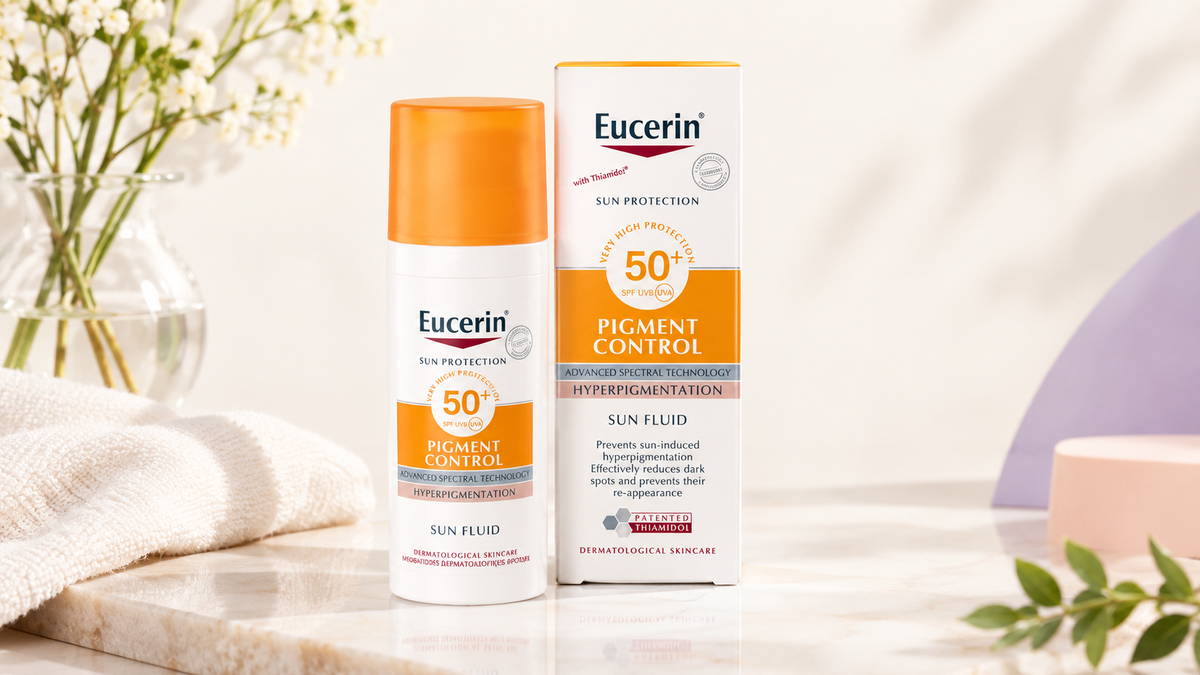
For those managing uneven skin tone and looking to prevent the exacerbation of dark spots caused by relentless UVA exposure, Eucerin Pigment Control SPF 50+ Sun Fluid 50ml provides focused daily protection with a sophisticated, non-greasy finish. Alternatively, if your priority is pure, weightless hydration that melts immediately into the skin like a fresh glass of water, Eucerin Sun Protection Hydro Protect SPF 50+ Ultra-Light Fluid 50ml delivers high-level shielding without leaving any trace of residue or tackiness.
Those with oily or combination skin who crave a velvety, clean matte sensation will appreciate Heliocare 360 Gel Oil-Free Sunscreen SPF 50 Dry Touch 50m, which dries down to an imperceptible dry-touch feel suitable for humid or damp climates. And for mid-day top-ups without disturbing your base, keeping Skin1004 Madagascar Centella Hyalu-Cica Silky-Fit Sun Stick SPF50+ PA++++ – Lightweight Invisible Sun Protection (20g) in your bag ensures you can glide seamless protection across your cheekbones and forehead, even while walking between meetings under overcast skies.
 Eucerin Pigment Control SPF 50+ Sun Fluid 50ml$21.8 $27.0
 Skin1004 Madagascar Centella Hyalu-Cica Silky-Fit Sun Stick SPF50+ PA++++ – Lightweight Invisible Sun Protection (20g)$14.5
 Vichy Capital Soleil UV-Clear Anti-Imperfections Water Fluid SPF 50+ – 40 ml$28.7 $34.0
 Eucerin Sun Protection Hydro Protect SPF 50+ Ultra-Light Fluid 50ml$19.0
 Heliocare 360 Gel Oil-Free Sunscreen SPF 50 Dry Touch 50m$24.8 $31.0
Building an intuitive morning protection ritual
The key to foolproof sun protection is removing the morning weather check from your mental checklist entirely. When you treat broad-spectrum defense as the final, non-negotiable sealing layer of your skincare regimen—identical to brushing your teeth or applying moisturizer—you safeguard your skin against ambient, incidental exposure without having to make a daily judgment call.
-
1. Cleanse and balance your skin
Begin with a gentle, non-stripping cleanser to remove nighttime oils and prepare your skin barrier for optimal product absorption.
-
2. Apply targeted hydration and serums
Smooth on your daily antioxidant or hydrating serums, allowing them a moment to sink in before applying heavier layers.
-
3. Measure an adequate sunscreen dose
Dispense approximately two finger-lengths of fluid to guarantee your face, neck, and ears receive the true rated protection on the label.
-
4. Smooth evenly across exposed zones
Gently massage the fluid outward in sweeping motions, taking care not to miss delicate areas like the eyelids, hairline, and clavicle.
-
5. Carry portable protection for touch-ups
Keep a featherweight stick or compact fluid in your tote for effortless reapplication during afternoon outdoor errands.
Frequently asked questions about overcast sun
Frequently asked questions
Can I really get sun damage when it is raining or foggy?
Yes, because up to eighty percent of ultraviolet A rays penetrate through cloud cover, rain, and dense fog. While you are unlikely to experience a surface burn from UVB rays, UVA radiation still reaches deep skin layers.
Do I need sunscreen if I stay indoors on a cloudy day?
If you sit near windows or work in a sunlit room, daily sunscreen remains important. Standard glass blocks burning UVB light but allows the vast majority of aging UVA light to pass through directly onto your skin.
Is SPF 30 enough for an overcast day, or do I need SPF 50?
An SPF 30 blocks approximately ninety-seven percent of UVB rays, while SPF 50 blocks ninety-eight percent. Both are effective, provided you apply a generous amount and select a broad-spectrum formula that guards against UVA.
How often should I reapply sunscreen if the sun is not visible?
Standard dermatological guidelines recommend reapplying every two hours if you are continuously outdoors, regardless of cloud density. If you work indoors away from windows, a diligent morning application with a mid-day refresh before outdoor exposure is generally sufficient.
Reframing sun protection as daily care
Protecting your skin should never feel like an anxious, fear-driven exercise in hypervigilance. Rather, wearing a high-performance pharmacy fluid every single morning is one of the kindest, most grounding rituals you can offer yourself. It is a quiet declaration that your skin barrier deserves consistent support, comfort, and defense, regardless of whether the day brings brilliant sunshine, gentle drizzle, or a canopy of thick grey clouds.
When you transition to modern, featherlight pharmacy formulations, sunscreen stops feeling like a chore reserved for the dog days of summer. Instead, it becomes an invisible, protective veil that lets you step outside into the crisp morning air, confident that your skin is nurtured, cushioned, and preserved for decades to come.