Article: Micro-needling at Home: Is It a Shortcut to Better Skin or a Risky Business?
Micro-needling at Home: Is It a Shortcut to Better Skin or a Risky Business?

The allure and anatomy of mechanical rolling
The appeal of at-home microneedling is almost deceptively simple. In a beauty landscape driven by high-tech gadgets and clinical procedures made domestic, the promise of transforming skin texture with a pocket-sized roller studded with hundreds of tiny surgical needles feels like the ultimate democratisation of cosmetic medicine. We are told that by gently puncturing the epidermis, we can simulate the in-office collagen-induction therapy performed by board-certified dermatologists, coaxing stubborn post-acne marks, fine lines, and dullness into smooth, plump submission. Yet between the glossy tutorials on social feeds and the reality of physiological tissue trauma lies a substantial scientific divide that demands sober evaluation.
In clinical dermatology, microneedling is also known as percutaneous collagen induction. The principle relies on creating controlled physical puncture wounds that extend down into the dermis. This controlled physical trauma triggers a cascade of wound-healing processes: initial platelets release growth factors, inflammation sets in, fibroblasts migrate to synthesize new collagen and elastin fibers, and tissue remodelling follows over several months. However, the operational word in clinical practice is controlled. When the same concept is scaled down to a plastic device kept in a humid bathroom cabinet, the biological calculus shifts dramatically from measured tissue induction to uncontrolled barrier compromise.
Understanding needle depth and biological thresholds
To assess whether at-home micro-needling works or poses genuine harm, one must first understand needle geometry and skin histology. The human epidermis—the outermost protective shield—ranges in thickness across the face, generally hovering between 0.05 millimeters on the delicate periorbital zone and around 0.1 to 0.2 millimeters across the cheeks and forehead. Immediately below sits the dermal-epidermal junction, followed by the dermis, where fibroblasts and the primary structural matrix of type I and type III collagen reside.
True collagen synthesis requires reaching the papillary and reticular dermis, which necessitates needle lengths between 1.0 millimeter and 2.5 millimeters. Such depths involve significant vascular puncture, pinpoint bleeding, intense inflammatory activation, and stringent aseptic protocols. Home rollers, by contrast, are legally and safely capped at superficial lengths—typically 0.2 millimeters to 0.3 millimeters, occasionally marketed up to 0.5 millimeters. At 0.2 millimeters, a needle barely penetrates the stratum corneum, the dead outermost layer of corneocytes embedded in a lipid bilayer.
At this superficial depth, mechanical rolling cannot physically trigger neocollagenesis. Fibroblasts situated deep within the dermis remain unaware of microscopic superficial punctures happening hundreds of micrometers above them. Therefore, claims that a consumer-grade 0.2 millimeter roller will erase deep structural wrinkles, raise pitted acne scars, or replicate an in-office fractional treatment are biologically ungrounded. What home rollers do achieve, however, is a temporary disruption of the stratum corneum, briefly increasing the transdermal flux of topical solutions before the cellular pores naturally seal within a few hours.
The engineering flaws of circular rolling
Even when used strictly for cosmetic product penetration, the physical architecture of hand-held dermal rollers introduces mechanical risks that professional clinical tools are designed to eliminate. In a medical clinic, microneedling is almost universally performed using automated mechanical pens. These devices drive sterile, single-use needle cartridges straight up and down in a 90-degree vertical axis, entering and exiting the tissue cleanly without horizontal shear.
A manual roller, conversely, relies on a cylindrical wheel rotating across curved facial planes. As the wheel turns, the needle enters the epidermis at an acute angle, tilts as the drum rotates forward over the skin, and then levers itself out at an opposing oblique angle. This arching motion creates microscopic track marks, tearing tissue laterally rather than stamping it vertically. Over time, repeated microscopic shearing of the stratum corneum causes uneven micro-fissuring, inflammation, and cellular micro-scarring that can degrade rather than refine skin texture.
Furthermore, the quality of consumer-grade needle metals varies widely. While professional devices use precisely calibrated, surgical-grade stainless steel or medical titanium, inexpensive home rollers frequently employ stamped metal alloys. After just a few uses across tough skin, these diminutive metal tips bend, dull, and develop microscopic burrs or hooks. A hooked needle dragged across the face does not create a clean micro-channel; it violently gouges the surface, inducing chronic inflammation and predisposing the complexion to post-inflammatory hyperpigmentation, particularly in higher Fitzpatrick skin phototypes.
Infection, granulomas, and the hygiene dilemma
The most pressing hazard of home microneedling lies in the impossibility of maintaining an aseptic field in a residential bathroom. In clinical settings, the treatment area is thoroughly prepped with medical antiseptics like chlorhexidine, practitioners wear sterile gloves, and needle cartridges are disposable, single-use, and sealed in sterile packaging. Post-treatment tools are incinerated in biohazard containers.
At home, consumers routinely attempt to sterilize multi-use rolling drums using standard 70 percent isopropyl alcohol. While alcohol cleanses superficial grime, it does not achieve true medical sterilization or destroy resilient bacterial spores. Skin sebum, dead cellular debris, and cosmetic residue accumulate at the base of the hundreds of needle hubs where alcohol cannot effectively dissolve them. When the roller is passed across the face again days or weeks later, it acts as an inoculating wand, mechanically driving ambient bathroom bacteria, Cutibacterium acnes, and Staphylococcus aureus deep into the breached skin barrier.
This inoculation frequently results in widespread folliculitis, spreading bacterial eruptions that mimic severe acne, or stubborn fungal infections. More insidiously, when home users roll over active cystic blemishes, they rupture infected sebaceous units beneath the surface, seeding bacteria across clear quadrants of the face and precipitating widespread secondary flares.
Topical toxicity and the phenomenon of foreign body granulomas
Beyond microbial contamination, home microneedling introduces an under-discussed biochemical threat: the inappropriate delivery of everyday cosmetic formulas into the living layers of the epidermis. Cosmetic serums are formulated exclusively for intact, healthy skin. They contain emulsifiers, thickeners, synthetic preservatives like phenoxyethanol, penetration enhancers, stabilizing chelators, and artificial fragrances. When applied to intact skin, the stratum corneum acts as a selective filter, allowing certain lipophilic actives to permeate while keeping bulk excipients safely on the surface.
When these same topical lotions are massaged into skin that has just been mechanically perforated with hundreds of micro-tunnels, the skin is suddenly inundated with complex chemical cocktails that were never evaluated for dermal or transdermal injection. Deeply deposited excipients can trigger acute type IV allergic contact dermatitis or chronic foreign body granulomas—hard, inflammatory subcutaneous nodules that form when immune macrophages engulf insoluble cosmetic particles they cannot degrade. These granulomas can persist for years and often require intralesional steroid injections or surgical intervention to resolve.
Even active ingredients widely celebrated for routine use can become fiercely destructive when driven artificially deep. High-strength L-ascorbic acid, exfoliating glycolic acid, synthetic retinoids, and potent botanical extracts, when applied immediately after mechanical puncture, trigger intense neurogenic inflammation, prolonged erythema, cellular toxicity, and sudden post-inflammatory pigment deposition.
 Uriage Bariéderm-CICA Cream with Copper-Zinc 40ml – Repairs & Soothes$11.9 $19.0
 Eucerin Aquaphor Baume Réparateur Skin Repair Balm 40g$8.4 $15.95
 La Roche-Posay Cicaplast Baume B5+ Ultra-Repairing Soothing Balm 100ml$23.0
 La Roche-Posay Cicaplast B5 Spray 100ml$18.2 $25.0
 Elastoplast Wound Healing Ointment Skin Repair & Protection 20g$8.8
Rebuilding the compromised barrier: a restorative pharmacy approach
When the skin barrier has been mechanically stressed, stripped, or over-sensitized by misguided mechanical tools, the primary dermatological objective must immediately pivot away from aggressive resurfacing and toward physiological lipid replenishment. Continuing to use active exfoliants or abrasive treatments on compromised tissue only perpetuates an inflammatory state that degrades collagen rather than building it.
French pharmacy skincare has long excelled at formulating minimalist, highly tolerable barrier-repair solutions designed specifically for stressed, fragile, and post-procedure complexions. Rather than bombarding the face with multi-ingredient botanical tinctures, restorative formulations focus on skin-identical lipids, soothing humectants, and anti-microbial mineral complexes.
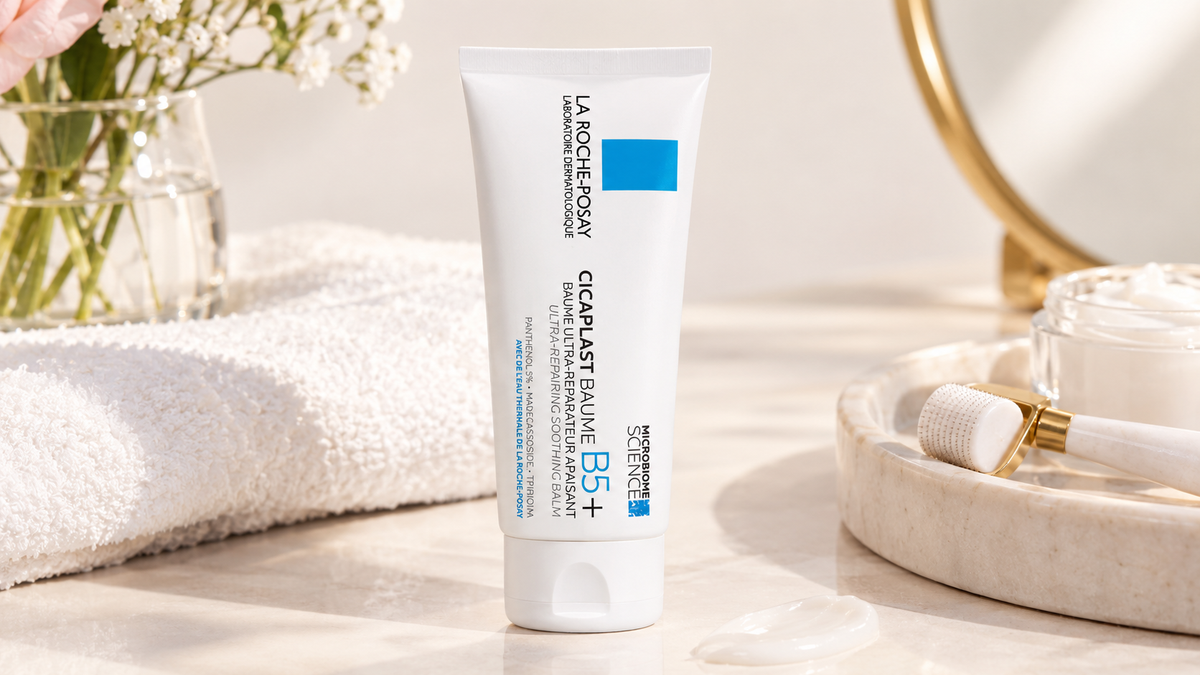
A quintessential staple for soothing mechanically challenged skin is La Roche-Posay Cicaplast Baume B5+ Ultra-Repairing Soothing Balm. Formulated with panthenol (provitamin B5) and madecassoside, this rich, comforting balm envelops the skin in a protective layer that helps leave skin feeling calmer, more comfortable, and visibly more even-toned. For skin that feels too sensitive to tolerate physical friction from rubbing thick lotions, La Roche-Posay Cicaplast B5 Spray delivers an invisible, touch-free mist of soothing moisture that leaves the delicate surface feeling refreshed and settled without any disturbance.
Similarly, when raw or compromised tissue requires purified mineral shielding, Uriage Bariéderm-CICA Cream with Copper-Zinc offers an exceptional barrier-insulating texture. The inclusion of copper and zinc lends the formula a purifying character well suited to fragile, easily congested skin, while its patented complex helps shield against external aggressors. For localized, cracked areas needing an intensive occlusive seal, Eucerin Aquaphor Baume Réparateur Skin Repair Balm creates a semi-permeable protective shield that leaves skin feeling deeply nourished and comfortably cushioned against environmental stressors.
Evaluating clinical microneedling versus domestic maintenance
Does this mean microneedling as a therapeutic modality is fundamentally flawed? Not at all. In the hands of a licensed medical practitioner, clinical microneedling remains one of the most effective, research-backed modalities available for addressing atrophic acne scars, textural irregularities, and loss of structural firmness. The clinical paradigm succeeds because every variable is strictly regulated.
In an office setting, needle depth is calibrated precisely to the individual patient's anatomical variations—using 0.5 millimeters on the bony temples and forehead, and adjusting up to 2.0 millimeters or more on fibrotic cheek scars. The procedure is paired exclusively with sterile, medical-grade glide mediums—typically pure, unpreserved high-molecular-weight hyaluronic acid or platelet-rich plasma (PRP) derived from the patient's own blood. Sterility is maintained from start to finish, completely averting the infectious and granulomatous hazards inherent to home practice.
For at-home regimens, cosmetic science offers far safer, non-invasive pathways to achieve radiant, refined skin texture without jeopardizing barrier integrity. Well-formulated topical retinoids, such as retinaldehyde or retinol, promote cellular turnover and encourage structural collagen synthesis gradually and predictably over time. Gentle daily chemical exfoliants—such as buffered polyhydroxy acids (PHAs) or low-concentration lactic acid—efficiently loosen cellular desmosomes to sweep away dull corneocytes without causing track marks, mechanical shearing, or chronic micro-inflammation.
The verdict on home microneedling
When weighing the cosmetic benefits of home microneedling against its biological hazards, the scientific evidence reveals an unfavorable risk-to-reward ratio. The structural collagen renewal that consumers desire cannot be induced by superficial, sub-millimeter needle lengths. Meanwhile, the very real perils of bacterial contamination, metal burrs tearing fragile tissue, and chemical irritants breaching the deep epidermis make home rolling an unnecessary gamble with your complexion.
Achieving healthy, resilient, and luminous skin does not require aggressive domestic puncturing. By leaning into well-researched chemical actives applied to an intact skin barrier, and supporting that barrier with restorative French pharmacy essentials like La Roche-Posay Cicaplast Baume B5+ or Uriage Bariéderm-CICA Cream, you preserve the structural health of your epidermis. Leave the needles to sterile clinical suites where they belong, and treat your everyday skin barrier with the restorative gentleness it deserves.
Frequently asked questions
Can at-home microneedling stimulate collagen production?
No. Collagen synthesis requires needles to reach the deeper dermis at depths typically between 1.0 and 2.5 millimeters. At-home rollers are limited to superficial lengths around 0.2 to 0.3 millimeters, which merely pierce the outer dead cell layer without triggering fibroblasts.
Is it safe to sanitize a home roller with rubbing alcohol?
While 70 percent isopropyl alcohol disinfects surfaces, it does not achieve true medical sterilization or destroy bacterial spores embedded within the dense needle clusters. Residual skin oils and cellular debris often remain trapped, creating a vehicle for bacterial contamination.
What should I do if my skin barrier is inflamed from rolling?
Immediately cease all physical rolling and halt strong active ingredients such as retinoids, exfoliating acids, and vitamin C. Switch to comforting barrier-repair balms such as La Roche-Posay Cicaplast Baume B5+ or Uriage Bariéderm-CICA Cream to support recovery.
Can I use regular serums immediately after micro-rolling?
Applying conventional serums directly over freshly rolled skin is risky because standard cosmetic formulas contain preservatives, emulsifiers, and fragrances designed only for intact skin. When introduced into micro-punctures, these excipients can trigger allergic reactions or inflammatory granulomas.